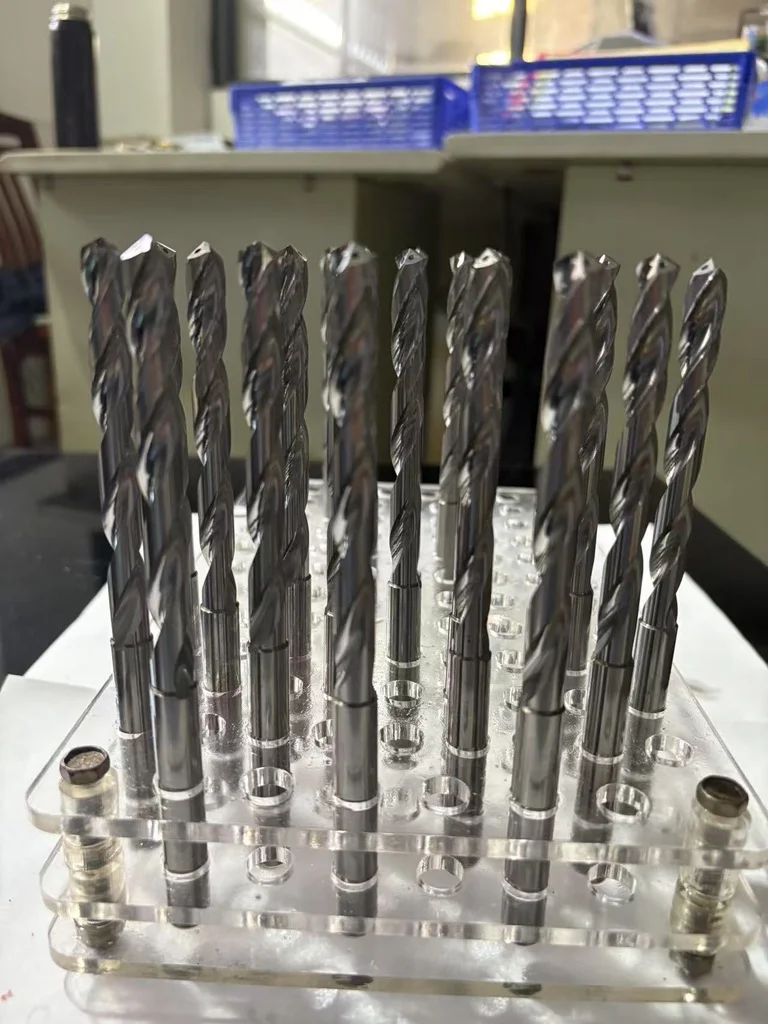
DIN 1897 identifies the stub series of parallel-shank twist drills. It is a length-family designation, not a statement that every short drill is solid carbide, centre cutting in the same way, or suited to the same entry condition. This guide explains the size fields to confirm, common ordering mistakes and how to approach a supplier with a complete requirement.
What does DIN 1897 cover?
Where access permits a short tool, the buyer can compare a compact assembly with longer alternatives. Check the needed full-diameter depth before selecting it: the short flute and total length still need to clear the part and provide enough room for the point and chip evacuation.
The reference used here is DIN 1897:2006-11. Read the primary standard or manufacturer reference for the exact scope. For a purchase requiring formal conformance, identify the agreed edition and obtain the applicable standard and item drawing; the checklist below does not reproduce its complete dimensional tables.
Which sizes belong on the RFQ?
There is no single universal “DIN 1897 drill size.” A standard identifies a defined family or feature, while the order still needs a selected diameter and the relevant geometry. Record each size using the symbols on the supplier’s drawing, because symbol conventions can differ between catalogs. Use millimetres for dimensional fields and state any angular requirement separately.
| Size or specification field | What to confirm |
|---|---|
| Diameter | Nominal cutting diameter |
| Flute length | Stub-series item drawing |
| Overall length | Complete length in mm |
| Shank and holder | Required clamping diameter and engagement |
| Hole requirement | Full-diameter depth plus entry/exit condition |
If a catalog provides several rows for one diameter, preserve the full item code and any form or length suffix. Do not select a nearby row solely because the diameter matches. A tool’s nominal size, manufacturing tolerance and the component’s finished-hole tolerance are different pieces of information.
A practical selection mistake to avoid
A short hole beside a fixture may look suitable for a stub drill, yet the holder body can collide before the drill reaches depth. Review the assembled holder and tool outline rather than the drill alone. If extra reach is required, choose the appropriate construction explicitly instead of assuming that a longer flute is always the answer.
Who can supply DIN 1897 tooling?
Dormer Pramet and Gühring offer manufacturer information for conventional short-drill selection. Confirm the tool material and standard on the specific quoted model.
Use the linked catalog as a starting point, then request the exact item drawing, construction, size row and standard edition from the seller. A manufacturer’s broad tool portfolio is not evidence that every diameter or form is stocked, or that a custom proposal automatically conforms to DIN 1897.
Discuss a carbide alternative with KYTOOLS
KYTOOLS (Changzhou Kong Yun Precision Tools Co., Ltd.) publishes solid-carbide drill families and drawing-based tooling. If you are considering a carbide alternative or a special geometry, send the original standard requirement together with the part drawing and existing tool dimensions. Ask KYTOOLS to review the proposed construction and dimensional match before approval.
The published KYTOOLS catalog is the source for its listed models; this article does not declare those models compliant with every DIN number discussed. Keep any requirement for DIN 1897 conformance, including form, edition and inspection documentation, explicit in the inquiry.
A useful quotation and approval checklist
- Attach the component drawing and, if available, the existing tool drawing or printed catalog code.
- State the workpiece material, hole condition and required dimensions with units and tolerances.
- Identify the machine, holder or taper connection and the coolant arrangement.
- Name the required standard edition and any permitted deviations; request written confirmation on the proposed drawing.
- Agree quantity, measurement method, marking, quotation validity and delivery destination.
When comparing a conventional standard tool and a drawing-based carbide alternative, qualify the proposed process as well as the purchase description. Keep the approved drawing and inspection record with the item code so a later reorder refers to the same configuration.
Send your drill specification to KYTOOLS, or download the drill catalog and inquiry template.